 YPARC
What happens during a nerve block?
Nerves carry pain signals to the brain. During a block, a clinician places medication around a specific nerve or group of nerves. Local anaesthetic temporarily reduces the transmission of these signals. An anti-inflammatory medicine is added in some cases when indicated; it is not needed for every block. [1] [2] [8]
The word “block” does not mean that the nerve is permanently switched off or damaged. This article concerns medication-based blocks. Radiofrequency and nerve-destroying procedures are separate techniques with different indications. [1]
Its role in modern pain medicine
Blocks are used for surgical anaesthesia and postoperative pain relief, and for selected chronic pain conditions. For example, some nerve-root pain or headache conditions may be suitable after assessment. A block can also help identify which nerve pathway contributes to the pain. [1] [2] [4] [7]
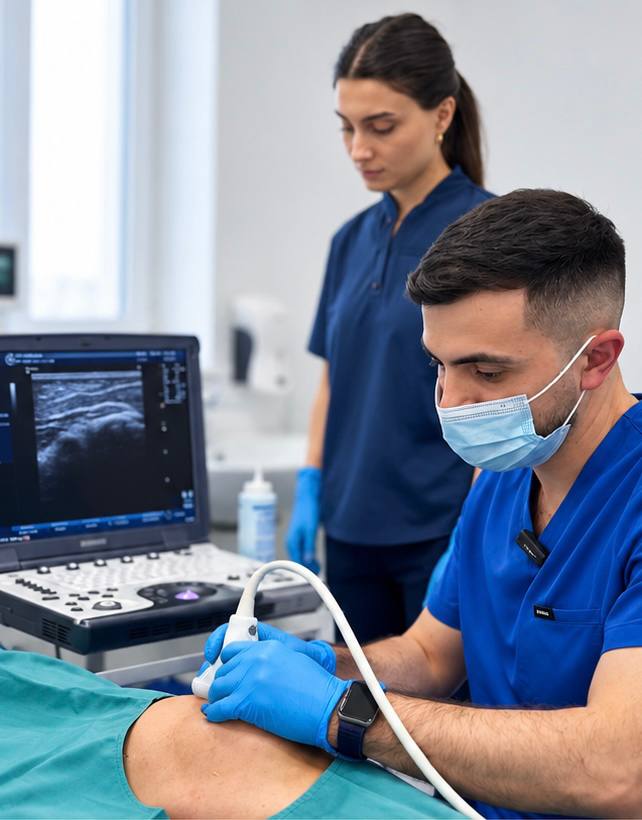
The strength of modern practice is targeted selection. Ultrasound, X-ray or CT guidance, when required for the procedure, helps locate the target and needle position. Blocks are not appropriate for every pain problem: for example, spinal injections are generally not recommended for non-specific low back pain. [1] [2] [6]
Treatment goals and duration of benefit
An intramuscular pain-relief injection is usually absorbed from muscle to act throughout the body. A nerve block places medication around a selected nerve to act on a particular pain pathway. Choosing it involves assessing the likely pain source and identifying an appropriate target. [1] [2]
A block can be a meaningful part of treatment even when its effect is time-limited. Pain relief may make rehabilitation easier; the response to a diagnostic block may guide the next treatment. Its therapeutic purpose and the duration of its effect are different questions. [2] [4] [6]
Local anaesthetic often works for hours. Any anti-inflammatory benefit, when that medicine is used, may develop later. Relief can be brief or longer-lasting, and some people obtain no meaningful benefit. A block does not always remove the underlying cause or permanently cure the condition. [3] [4] [7]
Why knowledge and skill matter
The clinician must assess symptoms, understand the position of nerves, vessels and nearby tissues, and choose the procedure, medication and dose. Appropriate guidance, skin preparation, sterile working, patient monitoring and readiness to manage complications are essential. [1] [2] [5] [8]
Follow-up matters too: how have pain, mobility and everyday function changed? A block may form part of a combined plan involving medication, exercise and other treatments. [1] [4] [7]
Making a more confident decision
Feeling anxious is natural. Beforehand, your clinician should explain the target nerve, expected benefit, what you may feel and the alternatives. The skin may be numbed first where needed. Temporary numbness or heaviness is expected after some blocks; discuss the likely duration and precautions. [4] [5]
Blocks are performed at different sites; they are not all spinal procedures. You can ask questions, explain your concerns and make an informed choice. Clear explanations, a trained clinician and safety measures provide a basis for confidence. [1] [5] [7]
Safety and preparation
Possible effects include soreness or bruising at the injection site and temporary numbness or weakness. Risks also include bleeding, infection, reactions to medication and, rarely, nerve injury. Your particular risks depend on the block and your health. Ultrasound guidance does not remove every risk. [5]
Tell your clinician about blood-thinning medicines, allergies, diabetes, infection and pregnancy or possible pregnancy. Do not stop medicines on your own. Ask for individual instructions about eating, getting home, driving and physical activity. [1] [3] [7] [8]
After a procedure, breathing difficulty, new or worsening weakness, fever, or marked redness and increasing pain at the injection site need urgent medical assessment. Contact the treating team if numbness lasts beyond the timeframe they advised. [5] [7]
Questions to ask
- Which nerve is being targeted, and why?
- Is the purpose treatment, diagnosis or both?
- What benefit and duration are realistic in my case?
- What comes next if the block helps—or does not help?
Medical sources
- ASRA Pain Medicine · Treatment options for chronic pain
- Cambridge University Hospitals · CT guided nerve root injection
- Royal Orthopaedic Hospital · Nerve root block
- Cambridge University Hospitals · Local anaesthetic nerve blocks after surgery
- ASRA Pain Medicine · Risks and benefits
- NICE NG59 · Low back pain and sciatica: recommendations
- Cambridge University Hospitals · Greater occipital nerve block for headache
- ASRA and partner societies · Corticosteroids for adult chronic pain interventions